
VISIT
SRI LANKA
THE PEARL OF THE INDIAN OCEAN
Trincomalee
Trincomalee also known as Gokanna, is the administrative headquarters of the Trincomalee District and major resort port city of Eastern Province, Sri Lanka.
Trincomalee has been one of the main centres of Sri Lankan Tamil language speaking culture on the island for over two millennia.
The city is built on a peninsula of the same name, which divides its inner and outer harbours.

People from Trincomalee are known as Trincomalians.
The recorded history of Trincomalee spans more than two and a half thousand years, beginning with civilian settlement associated with the Koneswaram temple in the pre-modern era.
One of the oldest cities in Asia, it has served as a major maritime seaport in the international trading history of the island with South East Asia
The city's architecture shows some of the best examples of interaction between native and European styles.
Attacked by the Japanese as part of the Indian Ocean raid during World War II in 1942, the city and district were affected after Sri Lanka gained independence in 1948, when the political relationship between Tamil and Sinhalese people deteriorated, erupting into civil war.
It is home to major naval and air force bases at the Trincomalee Garrison.
The city also has the largest Dutch fort on the island.
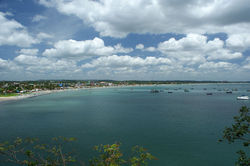
The Trincomalee Bay Harbour, bridged by the Mahavilli Ganga River to the south, is renowned for its large size and security; unlike any other in the Indian Ocean, it is accessible in all weathers to all craft.
It has been described as the "finest harbour in the world" and by the British, "the most valuable colonial possession on the globe, as giving to our Indian Empire a security which it had not enjoyed from elsewhere".
Popular tourist destinations include its beaches at Uppuveli, Salli and Nilaveli, used for temple visits, surfing, scuba diving, fishing and whale watching, and the Kanniya Hot Springs.
Trincomalee is served by a campus of the Eastern University, Sri Lanka and has been the inspiration of both domestic and international poetry, films, music and literature for many centuries.
Historical Sites
Trincomalee is sacred to Sri Lankan Tamils and Hindus around the world. The city has many Hindu sites of historical importance.
These sites are sacred to the Hindus and some Buddhists also worship at these Hindu sites.
Prominent sites include the Koneswaram temple compound, its Bhadrakali temple on Konesar Road, and the Salli Muthumariamman Kovil of Uppuveli beach in the Trincomalee suburb of Sambalativu.

Climate
Trincomalee features a tropical wet and dry climate (As) under the Köppen climate classification.
The city features a dry season from March through June and a wet season for the remainder of the year.
The city sees on average roughly 1,570 millimetres of precipitation annually.
Average temperatures in Trincomalee range from around 26 °C (79 °F) in December and January to approximately 30 °C (86 °F) during the warmest months of the year from April through September.

Attractions
 Koneswaram temple is a classical-medieval Hindu temple dedicated to Lord Shiva in Trincomalee, Eastern Sri Lanka. The temple is situated atop Konesar Malai, a promontory that overlooks the Indian Ocean, the nearby eastern coast, as well as Trincomalee Harbour or Gokarna Bay. Konesvaram is revered as one of the Pancha Ishwarams, of Sri Lanka for long time. Being a major place for Hindu pilgrimage, it was labelled "Rome of the Gentiles/Pagans of the Orient" in some records. |  |  |
|---|---|---|
 |  |  |
 |  |  |
 |  |  |
 |  |  |
 |